
Where does each room go in Vastu? Tradition puts the main door in the north, east or north-east, the kitchen in the south-east, the master bedroom in the south-west and the pooja room in the north-east. Toilets stay out of the north-east.
Where each room goes
| Room | Best direction | Why |
|---|---|---|
| Main door | North, east or north-east | Takes in morning light and the open side of the plot |
| Living room | North or east | The lightest part of the home, for guests |
| Kitchen | South-east, or north-west as second choice | South-east is the corner of Agni, the fire |
| Master bedroom | South-west | The heaviest, most settled part of the home |
| Children’s room | West or north-west | Suits those who will move out in time |
| Pooja room | North-east | The Ishan corner, the most sacred direction |
| Toilets | West or north-west, never north-east | Keeps waste away from the sacred corner |
| Staircase | South or west, rising clockwise | Weight stays on the south-west side |
| Overhead tank | South-west or west | Heavy loads sit on the south-west side |
| Underground water | North-east | Water belongs to the Ishan corner |
Follow your engineer on structure and safety first. Vastu is a tradition of placement, not a building code.
Room by room
The eight directions
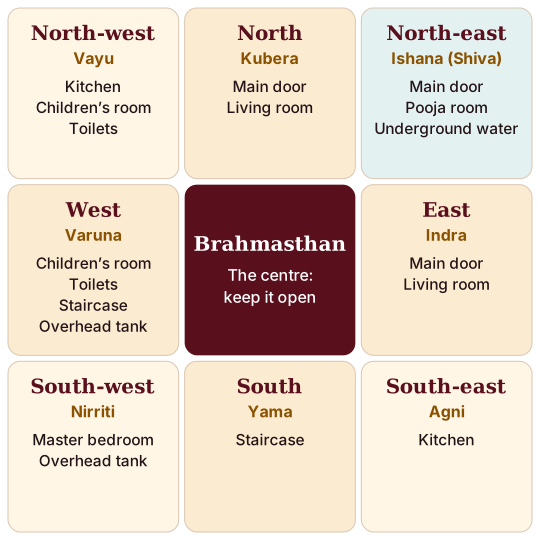
| Direction | Lord | Linked with |
|---|---|---|
| North | Kubera | Wealth |
| North-east | Ishana (Shiva) | Sacred space, clarity |
| East | Indra | Health, growth |
| South-east | Agni | Fire, cooking |
| South | Yama | Rest, weight |
| South-west | Nirriti | Stability |
| West | Varuna | Water, gains |
| North-west | Vayu | Movement, guests |
Sources
- Mayamata and Manasara, the classical Indian works on building.
- Brihat Samhita of Varahamihira, which has a chapter on Vastu.
- Many room-by-room tips are modern practice built on these works, so your own family’s custom counts too.
When the layout can’t change
Tradition doesn’t ask you to break walls. When a home can’t be rearranged, families hold a Vastu Shanti, usually before moving in.
Questions devotees ask us
Is Vastu needed for a flat?
The same ideas apply, but you can’t move walls. Families follow what they can, such as bed direction and the place of the mandir, and hold a Vastu Shanti when they move in.
When is a Vastu Shanti done?
Usually before or along with the griha pravesh, on a muhurat chosen by the pandit. It can also be done later in a home you already live in.
What is the most important Vastu rule?
Keep the north-east clean, light and open. If you follow only one rule, most pandits would suggest that one.