
Panchang and time
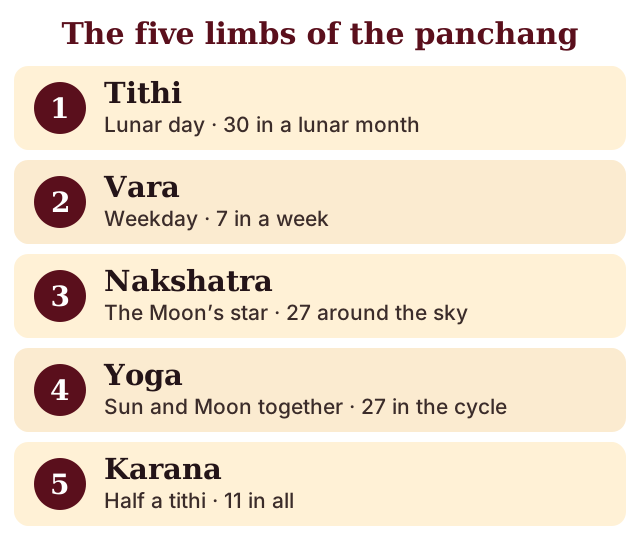
- Tithi
- A lunar day: the time the Moon takes to move 12 degrees further from the Sun, which gives 30 tithis in a lunar month, each about 20 to 27 hours long. Find today’s tithi →
- Vara
- The weekday, counted from one sunrise to the next, and one of the five limbs of the panchang. See which god is worshipped on which day →
- Nakshatra
- One of the 27 equal parts of the Moon’s path, each 13°20′ wide; the one the Moon was in at your birth is your birth star. Find your nakshatra →
- Yoga
- One of 27 divisions worked out by adding the longitudes of the Sun and Moon, used to judge the quality of a time; it’s unrelated to the yoga of postures. See today’s yoga →
- Karana
- Half of a tithi, named from a set of 11; the panchang shows it mainly so that rites can avoid the karana called Vishti, or Bhadra. See today’s karana →
- Paksha
- A lunar fortnight of 15 tithis: Shukla paksha while the Moon grows, and Krishna paksha while it shrinks. See the 2027 calendar →
- Masa
- A lunar month such as Chaitra or Kartika, which ends on Amavasya in much of South and West India and on Purnima in most of the North. See the 2027 calendar →
- Ritu
- One of the six Hindu seasons, each about two months long: Vasanta, Grishma, Varsha, Sharad, Hemanta and Shishira. See the festival calendar →
- Ayana
- Either half of the solar year: Uttarayana, when the Sun moves north, and Dakshinayana, when it moves south. Find a shubh muhurat →
- Muhurta (muhurat)
- A unit of 48 minutes, a thirtieth of a day, and in everyday speech the good time chosen for an event. Find a shubh muhurat →
- Rahu Kalam
- A daily period of about 90 minutes, one-eighth of the daylight, when families avoid starting anything new; it falls at a different time each weekday. See today’s Rahu Kalam →
- Yamagandam
- Another one-eighth of the daylight, set by the weekday and linked with Yama, which families also avoid for new beginnings. See today’s Yamagandam →
- Gulika Kalam
- A daily period linked with Gulika, in tradition the son of Shani; it’s said that whatever starts in it tends to repeat. See today’s Gulika Kalam →
- Abhijit Muhurat
- The eighth of the 15 muhurtas between sunrise and sunset, around local noon, held to be good for most beginnings. See today’s Abhijit Muhurat →
- Brahma Muhurta
- The 48 minutes that end 48 minutes before sunrise, traditionally the best time for prayer and study. See today’s Brahma Muhurta →
- Choghadiya
- A division of the day and of the night into eight parts each, with each part marked good or bad, used widely in western India. See today’s Choghadiya →
- Ekadashi
- The 11th tithi of each fortnight, kept as a fast by devotees of Vishnu, so it comes about twice a month. See Ekadashi dates for 2027 →
- Purnima
- The full moon, the last tithi of Shukla paksha and a common day for the Satyanarayana puja. See Purnima dates for 2027 →
- Amavasya
- The new moon, the last tithi of Krishna paksha and the usual day for offering tarpanam to ancestors. See Amavasya dates for 2027 →
The five limbs of the panchang
Stars and the birth chart
- Rashi
- One of the 12 signs of the zodiac, each 30 degrees wide; in Indian astrology your rashi usually means the sign the Moon was in at your birth. Find your rashi →
- Lagna
- The sign rising on the eastern horizon at the moment of birth, which sets the first house of the chart. Find your lagna →
- Graha
- One of the nine influences read in a chart: the Sun, Moon, Mars, Mercury, Jupiter, Venus, Saturn, Rahu and Ketu. Meet the nine grahas →
- Dasha
- A planetary period in a person’s life; the Vimshottari system runs nine of them over 120 years, in an order set by the birth nakshatra. Have your chart read →
- Gochar
- The present movement of the grahas through the signs, read against your Moon sign. Read today’s rashifal →
- Pada
- One of the four quarters of a nakshatra, each 3°20′ wide, which gives the first sound of a traditional name. Browse baby names →
- Gana
- The temperament given to each nakshatra, one of Deva, Manushya or Rakshasa, which is compared when horoscopes are matched. Book a kundli milan call →
- Nadi
- One of three types, Adi, Madhya or Antya, given to each nakshatra; it carries the most weight in horoscope matching, 8 of the 36 points. Book a kundli milan call →
Puja and ritual
- Sankalpa
- The spoken resolve at the start of a puja, which names the date, the place, the family and the purpose. See how a Satyanarayana puja is done →
- Yajna
- A Vedic act of worship in which offerings are made into a sacred fire with mantras. Browse homams →
- Homam
- A fire ritual in which ghee, grains and herbs are offered into a consecrated fire while mantras are recited; in North India it’s usually called a havan. Book a Ganapathi Homam →
- Abhishekam
- The ritual bathing of a deity or linga with water, milk, honey and other offerings while mantras are chanted. Book a Rudrabhishekam →
- Japa
- The repetition of a mantra or a divine name, often counted on a mala of 108 beads. Browse japams →
- Pradakshina
- Walking clockwise around a deity, temple or sacred fire, keeping it on your right. Book a temple puja in your name →
- Prasadam
- Food offered to the deity and then shared as a blessing. Send an offering to a temple →
- Samagri
- The items a puja needs, such as turmeric, kumkum, flowers, fruit and ghee; your pandit shares the list after booking. See a griha pravesh samagri list →
- Dakshina
- The offering made to a pandit for performing a rite. See puja prices →
- Kalash
- A pot of water topped with mango leaves and a coconut, set up to invite the deity at the start of a puja. Book a Navratri puja →
- Aarti
- The waving of lit lamps before a deity, usually with a song, near the end of worship. Read aarti lyrics →
- Vrat
- A vow kept on a chosen day, usually with a fast and worship. See the vrat calendar →
- Samskara
- A rite that marks a stage of life, from before birth to after death; tradition counts sixteen. See the 16 samskaras →
Put these into practice
Questions devotees ask us
What are the five limbs of the panchang?
Tithi, Vara, Nakshatra, Yoga and Karana. Together they describe a day at a given place.
What is the difference between a tithi and a day?
A day runs from one sunrise to the next. A tithi depends on the Moon and the Sun, so it can begin at any hour and can be shorter or longer than a day.
What is the difference between a rashi and a nakshatra?
A rashi is one of 12 signs, each 30 degrees wide. A nakshatra is one of 27 smaller divisions, each 13°20′ wide. At your birth the Moon was in one of each.